


Non-Profit declares war on blight
-
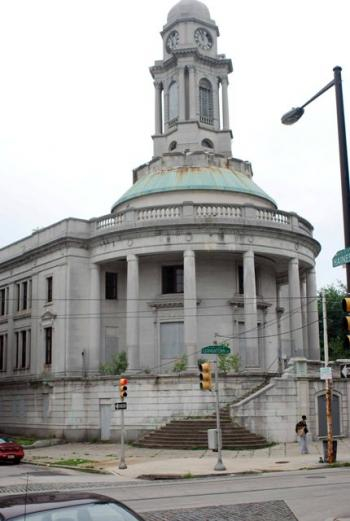
Germantown Town Hall
-
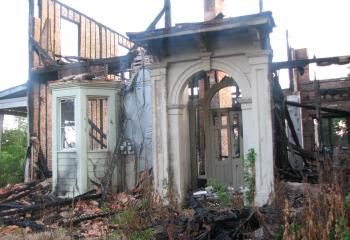
Remains of Garrett-Dunn House
-
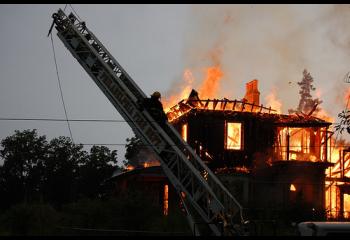
Garrett-Dunn House fully involved
Oct. 31, 2009
By Alan Jaffe
For PlanPhilly
They’re calling it the “first shot fired in the Second Battle of Germantown.”
A new non-profit, the Germantown Conservancy, filed a petition Oct. 26 in the Philadelphia Court of Common Pleas seeking conservatorship of more than 300 buildings and vacant lots in Germantown, Mt. Airy and Chestnut Hill in order to protect and restore them. The long list of sites includes historical and architectural landmarks such as Germantown Town Hall, Tulpehocken Train Station and the recently fire-ravaged Garrett-Dunn House, in addition to many other deteriorating properties.
Conservancy co-chair Peter Wirs said the petition is the first implementation of Act 135, the Abandoned and Blighted Property Conservatorship Act, which was signed into law by Gov. Rendell a year ago and went into effect Feb. 24. The Germantown Conservancy, a coalition of civic, community, historical and other non-profit groups within the 12th, 59th, 22nd and 9th Wards, was incorporated Feb. 9.
Act 135 is aimed at properties in which the owner has not abated building code violations that pose a danger to the community. If the owner does not correct the violations or satisfy the court-appointed conservator’s liens, the conservator can sell the property. The act moves vacant properties from government or private ownership to court oversight.
The Conservancy “will not target any individual residences that are occupied, even if they are not in compliance with the code,” Wirs said at a recent meeting of the organization’s board. “We deliberately limited ourselves.” A couple of apartment complexes on the list may be removed as well, he said.
But what is on the list is considerable: 331 parcels covering more than 5 million square feet. Over half of the projects owe a total of $2 million in city real estate taxes, according to the Conservancy. Ten percent are owned by the city or SEPTA; nearly 14 percent are owned by for-profit corporate, partnership or individual owners; 4 percent by non-profits, over 5 percent by religious institutions; and 16 percent by absentee owners.
“When you see the extent and degree of abandoned and blighted property in an area that is hallowed ground, not just in Germantown but the entire area, and you live with the extensive and rich history of Germantown, anybody worth his salt can see that Germantown possesses a unique opportunity to pull itself up, using Act 135, and restore the quality of life that all people are entitled to,” Wirs said.
Act 135 was introduced in the Pennsylvania House by Rep. Don Walko, of Pittsburgh, and co-sponsored by Rep. John Taylor, of the Port Richmond area, who brought the measure to Wirs’ attention. It is based on the Ohio Receivership Law, championed by Judge Raymond Pianka of the Cleveland Housing Court.
Christine Goldbeck, executive director on the Republican side of the Pennsylvania House Urban Affairs Committee, worked on the creation of Act 135. “We look at it as another tool that local governments have to fight blight and the social and economic consequences of blight,” Goldbeck said. “Let this problem be handled locally and let the court decide. In these cases, locals know best. At the state level, we’re trying to give them the authority and tools to do these things.”
Goldbeck said the act has already been applied in the borough of Saint Clair in Schuylkill County, where the court allowed a resident to buy a neighboring property for $1, under the condition that it be demolished within 90 days. “Demolition was not a top reason for doing conservatorship. But in this case, it took down an unsightly, dangerous property,” Goldbeck said.
“It’s so neat to see this law now being put into play, in small ways or in bigger ways, such as in Germantown.”
Developing Guidelines
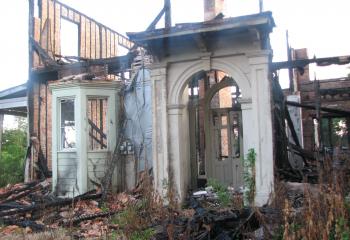
Remains of Garrett-Dunn House
Act 135 is not a form of eminent domain. It is not a government seizure of property for public purposes. Buildings targeted under Act 135 are in violation of municipal codes, and the conservatorship forces the owner to comply with existing laws. If the owner does not, the property can be sold after the conservator corrects any code violations.
The Philadelphia Court of Common Pleas issued a series of guidelines for implementation of the act on Oct. 2. Those guidelines require evidence on behalf of the conservator that the property meet at least three of the following conditions:
• That the city has declared the building to be a public nuisance;
• That no permits for rehabilitation work have been issued in the past 12 months and that the building is in need of substantial rehabilitation;
• Documentation that the building is unfit for occupancy;
• Documentation that the building is a fire risk to adjacent properties;
• Documentation that unauthorized entry is possible;
• Photos showing that the conditions are an “attractive nuisance” to children;
• Code citations that address the presence of vermin, debris, uncut vegetation, and deterioration of the structure or grounds.
• Photos that show the effect of the blighted property on the economic well-being of neighboring properties and the community.
• Or police reports regarding illicit activity at the property.
A Systematic Approach
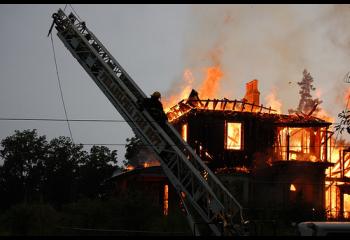
Garrett-Dunn House fully involved
The Conservancy’s plan is to transform Germantown’s unused, deteriorating housing from apartments into single-family homes and condominiums, and to preserve landmark properties that have been neglected by city or private owners. Financing will come, with court approval, from the Reinvestment Fund, the nonprofit financial institution. The plan proposes that the Philadelphia chapter of Habitat for Humanity act as intermediary for delivering rehabilitated homes to under-served families.
As a court-appointed conservator, the Conservancy’s job “is to basically flip the property,” Wirs said. The Conservancy will make sure the buildings are brought “up to code, then turn around and sell it if the building owner can’t satisfy the lien.”
The focus is on the area’s primary corridors: Germantown Avenue, Wayne Avenue, Chelten Avenue, Stenton Avenue, and “some of the more problematic cross streets,” Wirs said. “You have to have a systematic, integrated approach to eradicating urban blight. It cannot be done piecemeal. If we spend $150,000 to rehab a property at one end of the block and there remains blighted property on the other end, no one is going to buy the house that was rehabbed.”
Wirs said that as much as 80 percent of the properties under the conservatorship would have to be sold. Tax records show that liens have been outstanding on those properties for several years.
“Obviously, the economic downturn hit a lot of people,” Wirs said. “We know one homeowner who purchased a couple of houses right before the stock market and the banks crashed. We obviously can sympathize with her. But the problem is, those houses remain abandoned and blighted, and all of her neighbors are suffering a loss of property values. Whatever rights she may have, what about the neighbors? They have property rights.”
About 80 buildings targeted by the Conservancy petition are owned by religious entities, which probably can’t afford upkeep on what are often abandoned storefront properties. “The problem is, one abandoned house encourages others. If we don’t stop it now, we’ve seen the damage it causes.
“A lot of subprime mortgages are ready to come due,” Wir said, “ and we may have a whole new wave of abandoned houses dumped on us.”
Other property owners can afford to make necessary repairs but don’t, though they are in violation of various provisions of the building code. “They don’t have an excuse. But we’re going to give them an opportunity. Act 135 is your last call. You can get on the ball now,” Wirs said.
Wirs said he has been in contact with the state Attorney General’s Office, which has promised that there will be an aggressive approach to investigating and ending the sustained drug-trafficking that has contributed to problems throughout Germantown.
The Conservancy is “not a cure-all, solve-all” for those problems, Wirs said. “We have to walk hand in hand” with the City Planning Commission, the Redevelopment Authority, and the Office of Housing and Community Development throughout the process.
The Preservation Alliance for Greater Philadelphia, which has championed the protection of many sites on the Conservancy’s list, is anxious to see how the new non-profit fares in its large-scale implementation of Act 135. “We think the conservator law is an interesting law and presents some opportunities which should be tested,” said executive director John Gallery. “The fact that there’s a group of people in Germantown who want to use this law to go after some of the properties that have been neglected is a good thing.”
But some of the properties that appear on the Conservancy’s list, such as Germantown Town Hall, might have “unique circumstances” attached to their ownership, he noted.
Also, the “resources necessary to do some of them individually or collectively seemed enormous,” Gallery said. “My initial reaction was to wonder whether it would be better to begin with something more limited, something more strategic.”
Contact the reporter at alanjaffe@mac.com
WHYY is your source for fact-based, in-depth journalism and information. As a nonprofit organization, we rely on financial support from readers like you. Please give today.
Brought to you by PlanPhilly

PlanPhilly
In-depth, original reporting on housing, transportation, and development.