


DAGspace: Neither Black Nor White, Preservation is a Gray Area

Neither Black Nor White, Preservation is a Gray Area By Elise Vider
In 1955, Philadelphia significantly advanced the nascent historic preservation movement with the nation’s first citywide ordinance to protect historic buildings. Today, the city is once again poised to push the boundaries with a new dialogue about design in historic cities.
Gray Area: Provocations on the Future of Preservation is a convening of serious thinkers to consider preservation theory and practice, new design and the historic built environment amid new economic realities, demographic shifts, technological changes, environmental pressures and myriad fast-changing factors.
The title Gray Area is a reflection of the nuances and inherent tension between preserving the past and embracing the future. The project doesn’t aspire to provide definitive answers, but rather to provoke and address fundamental questions that are relevant to cities around the world, using Philadelphia as a point of departure.
Gray Area will consider, for example, how Philadelphia can best use its historic built environment as a catalyst for design invention, innovation and experimentation. What is worth preserving – neighborhoods, landscapes, buildings, interiors, stories? How can we create new ways of looking at old buildings? How do we protect Philadelphia’s greatest asset, its unique urban character? And what are the connections among preservation, environmental sustainability, emerging technologies and economic development?
These complex questions do not lend themselves to absolute answers, yet in reality stakeholders are often pushed into taking extreme rhetorical positions when preservation issues are considered in the politically charged settings of regulatory hearings, neighborhood meetings and the press.
So Gray Area’s agenda – itself a politically charged word – is quite simply to explode the conversation, to provoke a meaningful, no-holds-barred discourse on how preservation can meet the challenges of the constantly changing city. Everything should be on the table as we face the realities of the much vaunted “paradigm shift” that is underway.
Still, Gray Area does posit a few convictions. We believe that Philadelphia’s rich, historic built environment is a vast and underutilized asset. We advocate for preservation as design opportunity, not a limitation. We urge realism and recognition that traditional preservation strictures sometimes inadvertently lead to the demolition or continued vacancy of old buildings. And we contend that Philadelphia, with its urban characteristics and fabric, is the ideal laboratory for considering the future of preservation as a national and even global issue.
Gray Area grew out of a conversation last spring between Bill Adair, director of the Heritage Philadelphia Program at The Pew Center for Arts & Heritage, and Hilary Jay, founding director of DesignPhiladelphia, about how to ensure that preservation is relevant in the 21st century. The pair pulled together a group of preservationists, architects and others for several brainstorming sessions from which emerged this project. Brian Phillips, principal at Philadelphia’s Interface Studio Architects and a recipient of a 2011 Pew Fellowship in the arts, is the principal Gray Area curator, along with Deborah Grossberg Katz, Jay and me.
Gray Area comprises a free evening symposium (fully booked; get onto to the waitlist at www. grayarea.eventbrite.com) and the publication of a limited-edition catalog of built and unbuilt projects and “provocations” that reflect the imaginations of invited architects and designers. (The catalog will be available online at www.pcah us/heritage and www.pcah.us/fellowships.)
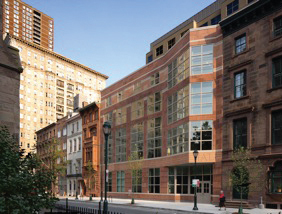
The projects chosen for the catalog don’t necessarily carry a Gray Area seal of approval, but were rather selected because of what they say about preservation past and present. Divided into “shells,” “platforms” and “voids,” they include works like Bower Lewis Thrower’s adaptive reuse of the landmark PSFS Building into the Loews Philadelphia Hotel, which included both careful restoration and literal rehabilitation. Enrique Norten’s proposal for an addition to the historic Free Library (never to be built; the commission went to Moshe Safdie) reflects an intriguing meld of old and new. VSBA’s Franklin Court was a highly innovative approach to preserving the memory of a long-gone building; a current project now poses new questions about preserving the 1976 design. Infill in historic contexts such as the new Lenfest Hall by VSBA, Skirkanich Hall by Tod Williams Billie Tsien Architects and Rag Flats by Onion Flats are also presented. And the Gray Area catalog takes a broad view of what constitutes preservation with highly conceptual “provocations” by design firms including Cheng Snyder, KBAS, IK Studio and PEG-OLA.
The Gray Area panel that convenes on October 19th will use the catalog as its jumping off point for what is expected to be a freewheeling conversation. Led by Mark Alan Hughes, distinguished senior fellow at Penn’s School of Design and founding director of Philadelphia’s Greenworks, as moderator, the panelists are: Lloyd Alter, the Toronto-based editor of Architecture and Design, TREEHUGGER.com; Randall Mason, chair, Graduate Program in Historic Preservation, Penn School of Design; Enrique Norten of TEN ARQUITECTOS in Mexico City; Susan Szenasy, editor in chief of Metropolis, the New York-based magazine of architecture and design; and Tod Williams of Tod Williams Billie Tsien Architects in New York.
Gray Area is produced as part of DesignPhiladelphia (October 13-23) and is supported by the Pew Center for Arts & Heritage through the Heritage Philadelphia program, with additional support by the Pew Fellowship in the Arts.
———
Elise Vider (elisevider.com) of Elise Vider Editorial Services is a writer, editor, a co-founder and member of the DAG Steering Committee and—full disclosure —project manager of Gray Area.

DAGspace is a monthly opinion column written by members of the Design Advocacy Group (DAG), with the goal of promoting good design by encouraging thoughtful public discussion of design matters. The mission of the Design Advocacy Group is to provide an independent and informed public voice for design quality in the architecture and physical planning of the Philadelphia region.
In addition to appearing on DAG’s website, you’ll be able to read DAGspace on Eyes on the Street every month. You can read previous DAGSpace articles here.
WHYY is your source for fact-based, in-depth journalism and information. As a nonprofit organization, we rely on financial support from readers like you. Please give today.
Brought to you by PlanPhilly

PlanPhilly
In-depth, original reporting on housing, transportation, and development.
Part of the series

Eyes on the Street
Eyes on the Street brings new ideas and fresh voices into the conversation about Philadelphia’s changing cityscape.
After nearly $80,000 in repairs, PhilaMOCA threatened with demolition
The Callowhill arts venue owned by the musician Diplo faces a threat from the city over problems with the historic building’s structural integrity.
3 years ago